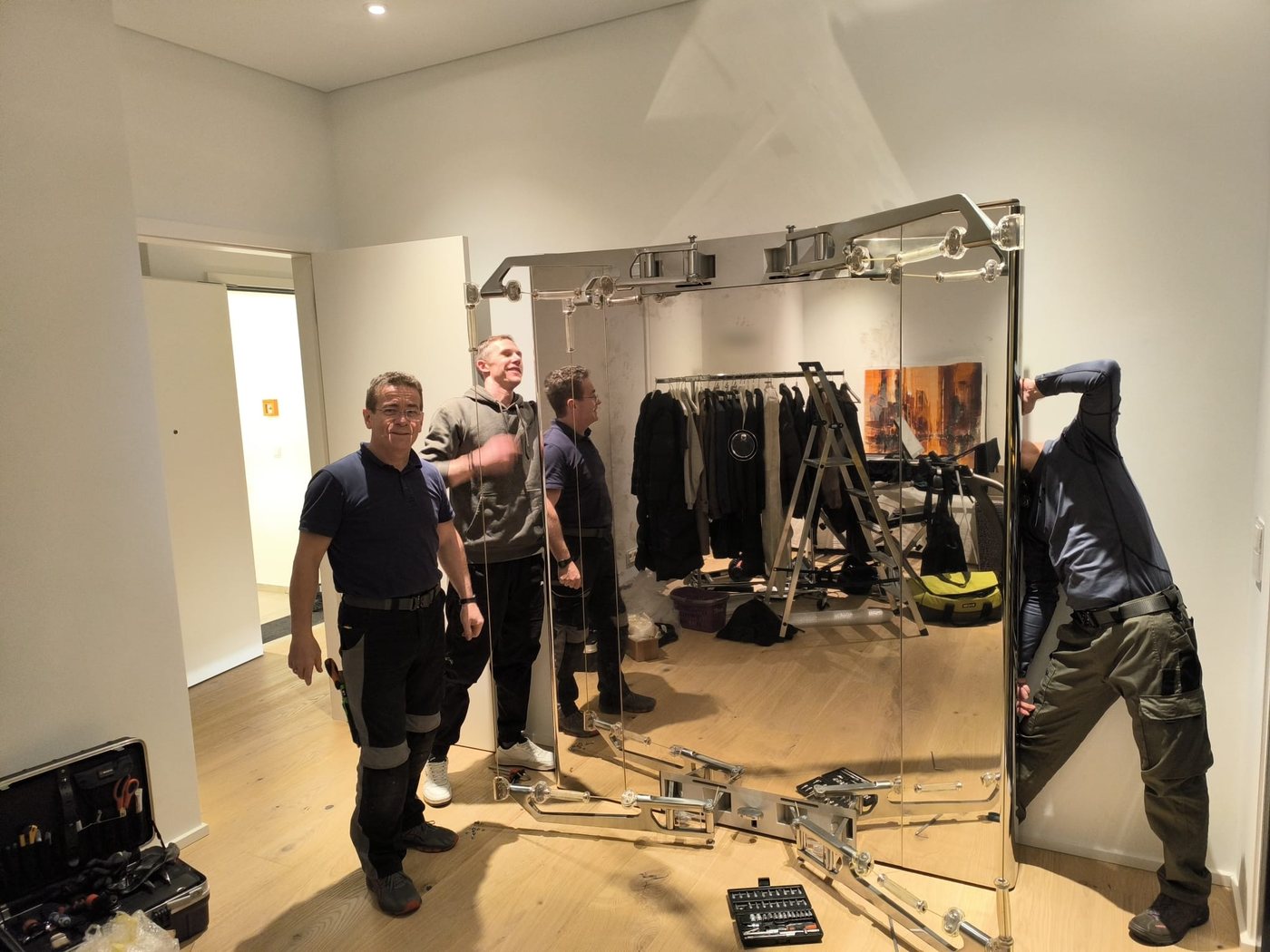
New machines are only as good as their assembly. We build, position, adjust, commission and test your equipment — from a single treadmill to a complete training room.
Assembly is the smallest part of an installation. Preparation and adjustment decide whether a machine runs well for years.
1
Delivery preparation
Access route, floor, door widths, lifts and staircases are clarified in advance — together with where each machine will stand.
2
Unpacking & check
Packaging is removed, parts are checked for completeness and transport damage before anything is bolted together.
3
Assembly
The machine is assembled according to the manufacturer specification, with the correct torque on load-bearing connections.
4
Positioning
Placement with usable space around the machine, sensible spacing for the training flow and consideration of power and ventilation.
5
Levelling & adjustment
Machines are levelled, belts tensioned and centred, cables and moving parts aligned and settings checked.
6
Commissioning
Electrical connection, first start, configuration of the console, language, units and any network or entertainment functions.
7
Functional test
Every machine is tested under load — running quality, resistance, noise, safety functions and display behaviour.
8
Handover & briefing
Handover with a short briefing on daily care, what to watch for and when the first maintenance visit makes sense.
Old packaging material can be a real problem in a finished room. Tell us in advance whether you want us to take it away or leave it on site for your own disposal.
Two assemblies step by step
From the crate to a machine ready for use
Two real jobs, three pictures each: how it arrived, how it looked mid-assembly and how it was handed over. Use the arrows to move through the photos.
Cable station in a company training room
Multi-function cable station, dumbbell area and accessories — assembled in one visit
Step 1 of 3Delivery and unpacking
Every sub-assembly is in the room, the wrapping is off, the frame stands loosely. Before anything is torqued down we check the parts list.
Step 2 of 3Assembly
The frame is levelled, plates and small parts are sorted. Each sub-assembly goes where it belongs before the next one is fitted.
Step 3 of 3Assembled and tested
Station bolted, cables run, plates loaded, function test done. The rest of the delivery is still waiting in the background.
Four-station cable machine in a sports hall
Cable machine with four training positions — assembled on site in the hall
Step 1 of 3Parts in the room
The machine arrives in pieces: frame sections, pads, handles and small parts lie individually wrapped on the hall floor.
Step 2 of 3Assembly
Frame and weight stacks are standing, the first training positions and benches are fitted. The remaining parts are still on the floor.
Step 3 of 3Finished and released
Four training positions, cables adjusted, pads fitted, floor cleared. Only then does the machine go into service.
Both examples are real jobs; the photos come from the work itself and are not staged. We do not name the operators.
Scope
What we install
Cardio equipment
Treadmills
Cross trainers and ellipticals
Indoor cycles and spinning bikes
Upright and recumbent bikes
Rowing machines
Stair climbers
Strength equipment
Selectorized machines
Plate-loaded machines
Cable stations and crossovers
Multifunctional stations
Racks, benches and frames
Functional training rigs
Complete projects
Complete gym rooms
Hotel and company fitness rooms
Physiotherapy and rehabilitation rooms
Residential building training rooms
Home gyms
Extension of an existing floor
Complete rooms
Fitting out a whole training room
Installing twenty machines is not twenty installations — it is one logistical exercise. The sequence of assembly, the route through the building, where machines are staged before they are placed and the order in which power connections are made all decide whether a fit-out takes one day or three.
We plan the sequence with you before the delivery arrives: what goes in first, which machines have to pass through which door, which units need a socket and where the free space in front of and beside each machine has to be.
That planning also protects the building. Fitness equipment is heavy and edges are unforgiving; floors, door frames and lift interiors are the things that get damaged when a delivery is improvised.
Not every installation is a project. A hotel that adds a second treadmill, a practice that receives a new therapy device, a household that has bought a multi-gym — these are single machines, and they still need to be assembled correctly and adjusted properly.
The same applies to moving equipment inside a building. Machines are often relocated from one room to another, from the basement to a new studio floor, or repositioned when a room is redesigned. Depending on the machine that means partial dismantling, transport in a controlled way, reassembly and a full readjustment.
What looks like carrying a machine across the corridor is in practice the point where alignment, belt tension and cable routing are most often lost — and where the noise complaints two weeks later come from.
Assembly of individual new machines
Repositioning within a room or building
Partial dismantling where doors or stairs require it
Full readjustment and functional test afterwards
Preparation
What to clarify before delivery day
Most installation problems are not assembly problems. They are access problems, floor problems or power problems that were discovered at the moment the pallet arrived. A short check in advance removes almost all of them.
Access
Door widths and corridor turns on the route to the room
Lift dimensions and load capacity, or the number of stairs
Where the delivery vehicle can stop and unload
Whether a time window applies for the building or the street
The room itself
Floor type and load capacity — especially for heavy strength equipment
Ceiling height for cable crossovers, racks and functional rigs
Free space required in front of, behind and beside each machine
Ventilation and heat: cardio equipment and closed rooms are a poor combination
Power and connections
Number and position of sockets — treadmills should not share a socket with several other machines
Whether machines are networked or connected to an entertainment system
Cable routing so that nothing runs across a walking line
Can you install machines that we bought elsewhere?
Yes. We are a service company, not a dealer — where the equipment comes from makes no difference. Send us the manufacturer and model list and we will tell you what the assembly involves.
Do you install complete gym rooms?
Yes, including the planning of the assembly sequence, routing through the building, positioning of every machine, commissioning and a functional test of each unit.
Can you remove our old equipment at the same time?
Yes. Dismantling and preparing old machines for transport or resale is part of our disassembly and relocation service and can be combined with an installation on the same day.
What happens if a machine does not fit through the door?
That is exactly why we ask about access in advance. Many machines can be partially dismantled for transport and reassembled in the room. Where that is not possible, we will tell you before the delivery is scheduled rather than on the day.
Do you install privately purchased home equipment?
Yes. Home treadmills, cross trainers, multi-gyms and racks are assembled, positioned, adjusted and tested in the same way as commercial equipment.
Is the machine ready to use after the installation?
Yes. Commissioning, configuration and a functional test under load are part of the installation. We hand over a machine that is running, not one that is standing in the right place.
Privacy settings
Here you decide what this website may store in your browser and load from elsewhere. Your choice stands until you change it.
Necessary
Always on
Basic functions such as navigation, language choice and sending the contact form. The site does not work without them, so they cannot be switched off.
Nothing to set right now
This website sets no analytics, advertising or tracking cookies, loads no third-party scripts, fonts, maps or videos, and includes no ad networks. There is therefore no optional consent for you to give.
The only thing stored:
Language choice (gsl_lang, localStorage) — only when you pick a language in the switcher yourself. No identifier, and it stays on your device.